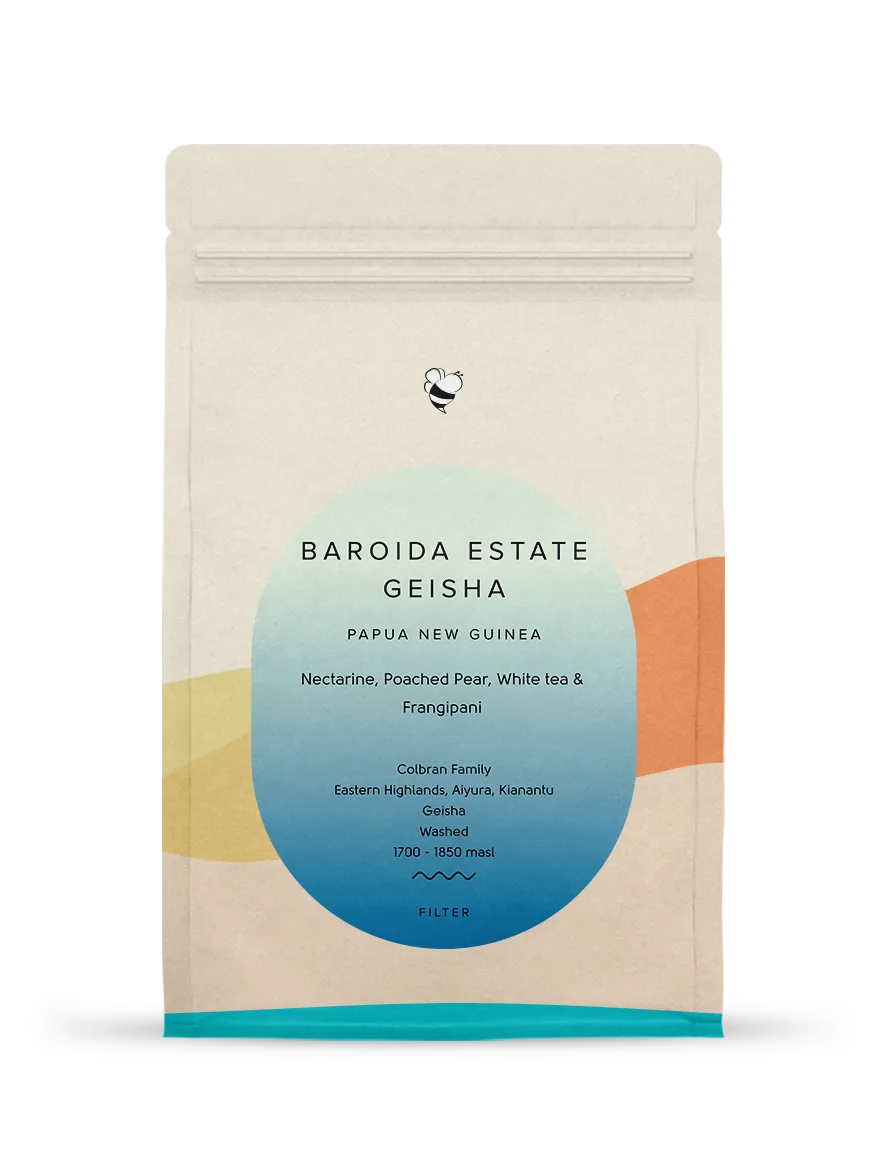
This single-variety Geisha lot is from Baroida Estate. Located in the Kainantu District, Eastern Highlands Province, the estate was founded by Ben Colbran in the 1960’s when the Government encouraged foreign agriculturalists to begin cultivating land throughout the highlands. Ben first purchased the land from a native man named Taro and was among the first farmer to cultivate coffee in these valleys. Today, Ben’s son Nichol runs the plantation.
As part of his never-ending efforts to expand and improve quality at Baroida Estate, Nichol planted 22,200 Geisha variety coffee plants in 2017. The first lot of Fully washed Geisha was produced in 2021. Given the excellent cup profile, Nichol has already moved forward with expanding his Geisha production. He is growing additional 800 Geisha seedlings in the nursery and 6,000 in the seedbeds.
The name ‘Baroida’ comes from the Baroida spirit, believed by locals to reside in a large river rock sitting in one of the main rivers flowing through the estate. This particular rock has stubbornly remained in the middle of the river for as long as anybody can remember, refusing to budge through the most severe floods and even when other rocks have been washed away.
The Baroida plantation sits at the apex of the Lamari river valley and Mount Jabarra range. The plantation itself sits at about 1,700 to 1,850 meters above sea level amongst thousands of hectares of cleared land with former colonial coffee estates surrounding them (now run by native landowners) and flanked by mountains filled with smallholder coffee producers who cultivate close to a million trees.
Meticulous separation for quality control helps maintain the high quality of the estate’s coffee. After careful sorting, cherry is pulped on disk pulpers. Then, it dry-ferments in vats for approximately 36 hours. Water is pumped into the vats in a circular motion to naturally agitate the coffee and remove any remaining mucilage. Parchment is sundried on tarps, where it is turned regularly to ensure even drying.
We source the best quality lots, which are separated and allocated specifically for us before being hulled, graded and prepared for export.
Geisha (also known as Gesha) is known for its exceptional cup quality, especially when grown at high altitudes. The variety comes from Ethiopian landrace coffees and was collected from Ethiopian coffee forests in the 1930s. The name supposedly derives from Ethiopia’s Gori Gesha forest.